|
The
BRAINERD
DAILY |
|
|
|
Domes constructed
from recycled or natural products |
HOME ECO DOMES IN THE MEDIA
|
The
BRAINERD
DAILY |
|
|
|
Domes constructed
from recycled or natural products |
|
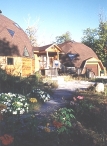
Consisting of nearly 10,000 square feet, the domes of The WATER Foundation
provide offices, meeting rooms, recording studios for the foundation’s
syndicated Bog Frog programs and a learning center for environmental
issues.
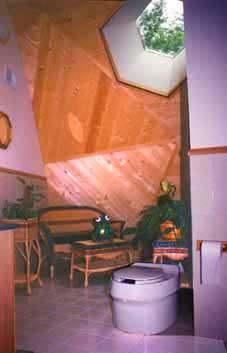
The building includes: --Composting toilets that prevent pollution of water bodies using natural sources to convert waste to a usable compost fertilizer. A high-tech system provides an environment for bacteria to eat waste as it does in nature. An odor-free composter uses temperature, humidity and ventilation to turn 150 system uses per day into a dry black powder called humus. About 2 percent of waste is not digested, creating about two pails of humus in 12 to 18 months time. --Paving constructed of recycled asphalt and concrete. --Decks made from recycled plastic, soda bottles and other high-density polyethylene HDPE and mixed with waste wood fiber. The material does not rot, sliver or crack and contains an ultra violet inhibitor. --Natural stone use maximized with Little Falls Granite Works providing granite plaques, flagstones and pavers. --Halo Power Track system by Cooper Lighting provided the house with compact fluorescent fixtures consuming 26 watts per bulb. --Energy efficient ceiling and wall fixtures used to house compact fluorescent light bulbs. It is estimated 30 percent of electric energy in the United States is for light alone. The WATER Foundation says that can be reduced five-fold wit fluorescent lighting. --Environmentally responsible paint from Ace Hardware Paint Division has low odor, and no heavy metals such as lead or mercury. Paint cleans up with water and is stain and mildew resistant. --A walk-in cooler, dubbed the root cellar, is an energy efficient natural refrigerator. Using the earth as a coolant plans call for a sand blanket to store vegetables like carrots and potatoes. Last your flowering plant bulbs were stored in the cellar. A round chamber that alters voice echoes, the cellar is formed by a steel substructure that acts as a Faraday cage in screening out cosmic radiation. Humidity and temperature are controlled with adjustable ventilation. --Permanent wood foundation for both domes was made from pressure treated wood. Considered more energy efficient than traditional block or concrete foundation, the wood is more resilient and lasts as long. --Cellulose insulation was used for its thermal resistance and sound reduction qualities. It is made from recycled paper, newspaper, office paper and corrugated paper. --Recessed lighting platforms are highly reflective and use compact fluorescent light bulbs, which consume 32 watts per bulb, compared to the typical 150-watt incandescent bulb. --Ceiling thermotile provide a thermal resistance, or R factor, of 4.55 per inch. Tiles are made from recycled polystyrene and have high light reflection without glare. Tiles are washable, reversible and do not shed fibers.
Environmentally friendlyDome structure uses wind, sun, earth for heating, cooling, power A geodesic building design is turning conservation talk into physical reality.
The entire dome structure, about 10,000 square feet, is
heated, cooled and powered by the wind, sun and earth.
Tours of foundation’s Eco Domes availableTours: Eco Domes will be available for specialized tours 8 a.m. to 8 p.m. today through Wednesday, national Earth Day. Tours are primarily designed for building contractors, engineers, architects, city planners and others interested in conservation friendly products and how they actually work in place. An open house tour for the general public is set June 26 through July 3. How to get there: The WATER Foundation is five miles east of Brainerd on Highway 18, then south for five miles on South Long Lake Road, also called County Road 23. |
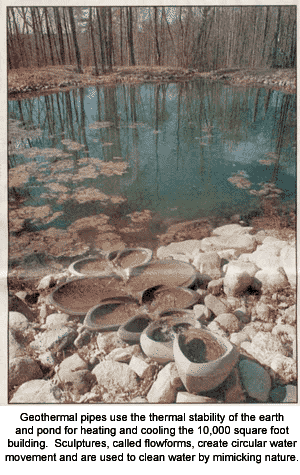 --Geothermal heating and air-conditioning systems us the earth’s power.