|
Bush Warms Up to
Conservation
By Tom Doggett and Chris Baltimore
WASHINGTON (Reuters) - The Bush administration acknowledged for the
first time in a new report that U.S. greenhouse gas emissions will
increase significantly over the next two decades due mostly to human
activities, but again rejected an international treaty to slow global
warming (news
- web
sites).
 The report released by the Environmental Protection Agency (news
- web
sites) was a surprising endorsement of what many scientists and
weather experts have long argued -- that human activities such as oil
refining, power plants and automobile emissions are important causes of
global warming. The report released by the Environmental Protection Agency (news
- web
sites) was a surprising endorsement of what many scientists and
weather experts have long argued -- that human activities such as oil
refining, power plants and automobile emissions are important causes of
global warming.
The White House had previously said there was not enough scientific
evidence to blame industrial emissions for global warming.
"Greenhouse gases are accumulating in the Earth's atmosphere as a
result of human activities, causing global mean surface air temperatures
and subsurface ocean temperatures to rise," the administration said
in its report.
That position puts the Bush administration at odds with its
supporters in the U.S. auto, oil and electricity industries, which
contend that more research is needed to determine if the changes are
naturally occurring or caused by industry.
In the report sent Friday to the United Nations, the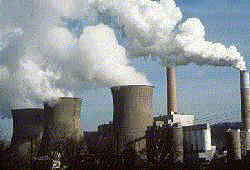 administration forecast that total U.S. greenhouse gas
emissions will increase 43 percent between 2000 and 2020.
administration forecast that total U.S. greenhouse gas
emissions will increase 43 percent between 2000 and 2020.
On the same day, all 15 European Union nations ratified the Kyoto pact -- the only global framework
for reducing emissions of greenhouse gases such as carbon dioxide and
soot.
The United States is the world's largest emitter of so- called
greenhouse gases, mostly from utilities and factories.
Last year, the Bush administration triggered international outrage
when it announced the United States would not participate in the Kyoto
Treaty, a U.N.-backed attempt to limit greenhouse gas emissions by
industrial countries.
At the time, President Bush (news
- web
sites) said the Kyoto Treaty's goal of reducing U.S. emissions by
about 7 percent from 1990 levels during 2008-2012 would be too costly to
the American economy.
Environmental groups said the new U.S. report was a major reversal by
Bush administration on the link between global warming and human
activity.
"(The report) undercuts everything the president has said about
global warming since he took office," said Philip Clapp, president
of the National Environmental Trust.
The Environmental Protection Agency posted the report on its Webs
site, but EPA officials refused to comment on its contents and referred
inquires to the State Department, which submitted the report to the
United Nations.
ALPINE MEADOWS, ISLANDS AT RISK
The administration warned that increased emissions and rising
temperatures will have a greater impact on certain regions of the United
States.
The report said average temperatures in the contiguous United States
will rise 5 degrees to 9 degrees Fahrenheit during this century.
Some highly sensitive ecosystems, such as Rocky Mountain meadows and
coastal barrier islands, will likely disappear, the report said.
Forest regions in the Southeastern United States could see
"major species shifts," or major changes in growth patterns.
The report also raises the possibility of drought conditions and
changing snowfall patterns in the West, Pacific Northwest and Alaska.
Average sea level rises of 19 inches from global warming could
threaten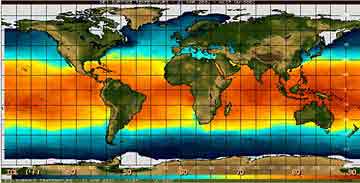 buildings, roads, power lines and other infrastructure in
climate-sensitive areas, the report said. buildings, roads, power lines and other infrastructure in
climate-sensitive areas, the report said.
"With higher sea level, coastal regions could be subject to
increased wind and flood damage, even if tropical storms do not change
in intensity," it said.
Though not referenced in the report, the impacts spell significant
dangers for coastal cities like New York City and New Orleans, Clapp
said.
With sea level rises referenced in the report, Manhattan would be
underwater up to Wall Street and New Orleans would have to undertake a
major dike-building effort to hold back the waters, Clapp said.
"The United States needs to take aggressive action now to
develop a program to reduce emissions," he said.
VOLUNTARY MEASURES
The administration repeated in the report that voluntary measures to
control emissions taken by polluting U.S. companies are the best way to
slow the growth of emissions that are believed to cause the earth's
atmosphere and oceans to warm.
A voluntary approach is "expected to achieve emission reductions
comparable to the average reductions prescribed by the Kyoto agreement,
but without the threats to economic growth that rigid national emission
limits would bring," the report said.
The White House reiterated its commitment to fighting global warming
and touted its plan to reduce the amount of emissions per unit of U.S.
gross domestic product by 18 percent over the next decade through a
combination of voluntary, incentive-based and mandatory measures.
The administration also pointed out that the United States had led
the world in investment in climate change science and since 1990 has
spent over $18 billion on such research.
A global summit in Johannesburg is planned for August with 60,000
delegates and 100 heads of state to discuss sustainable development,
with climate change issues slated for discussion.
The United States is expected to face heavy criticism at the meeting,
especially from the European Union, for not doing more to fight global
warming.
|