| Going
right to the source by
Brian Johnson*
David Winkelman was being interviewed for a newspaper story
about his Brainerd-based company, The
Water Foundation, when he paused for a moment to get on his soapbox.
"The only real capital in the world comes from nature,"
said Winkelman, a contractor-turned-conservationist who has 30 years
of experience in the construction business. ... "A tree is not
just so many board feet of lumber. Its a living, breathing organism
thats part of our health. So we encourage people to take a bigger
look at what really is here on earth and how we can be stewards of
it and maintain a profitable business."
That philosophy is the driving force behind Winkelmans
company, which spreads the message of conservation technologies through
radio programs, its Web site (http://www.bogfrog.com), consulting
services and sales of sustainable products.
With six employees who own stock in the company and about $2
million in annual sales, The Water Foundation bills itself as a link
between environmentally concerned businesses/individuals and conservation
technologies. Besides delivering conservation tips that are heard
on more than 200 radio stations, The Water Foundation provides energy
and water audits of existing buildings and design planning for energy-efficient
technologies in new buildings.
Many of those technologies are on display
at the companys headquarters, known as the Hop Shop Center. Located
just south of Brainerd, the domes were built with such earth-friendly
materials as recycled paving products, hardwoods from dead native
trees, energy efficient fluorescent track lighting and VOC-free paints
and sealers.
Solar electric panels, wind generators and geothermal heating
provide warmth, coolness and power for the three structures, which
were completed in 1998 at a cost of $500,000. Totaling 10,000 square
feet of space, the domes (including an underground structure) dont
burn any fuel, produce any waste or pollute any water, according to
company officials.
"Were trying to show the gamut of conservation technologies here at
the Eco Domes," said Winkelman, who has conducted numerous workshops and
seminars on energy technologies. "That's really the motto for our business-
"Conservation Pays."
As Winkelman was speaking, the temperature was a frigid 10 below zero in
Brainerd. But his office was comfortable, thanks to the warmth and energy generated by the earth, wind and sun.
"Even on a cold day in January, we can still get solar energy",
Winkelman said. "And theres actually more energy in January from the
sun, because there's less humidity."
Natural energy sources are saving the company about $350 every month in energy bills, according to
Winkelman. Excess energy generated by the domes, he added, is sold back to the local utility.
"It spins the meter backwards when were using less than we make,"
Winkelman said.
Construction roots
Winkelman, 50, got started in the construction business in 1969, when
he sat down with his father and brothers at the family kitchen table in St. Cloud.
Winkelman's father had been working for a construction company that had recently gone bankrupt after taking a bath on a couple
of projects.
"He had a crew of about 40 guys that were working for him," Winkelman
recalled. "He said, 'Lets try to get our own work.'"
That was the beginning of Winkelman Building Corp.
The family business started by getting just about any kind of work it
could find. Eventually, it landed a couple of big jobs, like the Municipal Sports Complex in St. Cloud, and it grew to become a $20
million to $30 million business.
While working in the family construction business, David Winkelman
developed an interest in energy and conservation technologies. He expanded on that interest by studying biophysics at St. Cloud State
University.
Winkelman never completed his degree at St. Cloud State because his
increasingly successful family business demanded too much time. But he did stick around long enough to complete 200 credits and help start a
group called Students for Environmental Defense, which he describes as a
"practical outlet for that pent-up desire to do something good for the
environment."
St. Cloud State was also the site of Winkelmans' first Eco Dome-type project. In 1974, he joined a group of students who built a small dome
on the campus. Six weeks after the project was completed, however, a group of vandals destroyed the structure.
Winkelman later tried to build another set of domes on property he
owned in St. Cloud, but that project was successfully opposed by neighbors and city officials who
"didn't" want such a weird structure in town, he recalled.
The Eco Domes project was greeted with far less opposition at its
current site near South Long Lake, about 10 miles southeast of Brainerd.
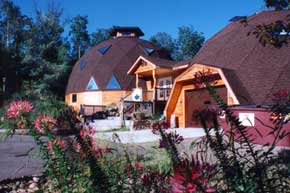
The domes, which are open Monday through Friday for tours, have become a local center for the arts as well as the headquarters of the
Water Foundation.
Tours and publicity about the Eco Domes continue to educate people about
alternative energy sources. Still, public awareness of sustainable construction remains low, according to a recent report from the Georgia
Institute of Technology.
The report, "Sustainable Construction in the United States of
America," indicates that many designers and contractors hesitate to use
untested building materials because of liability issues. Building codes, regulatory restrictions and the sheer number of potential
resources available to designers and contractors also provide roadblocks to sustainable design methods, the report noted.
None of those roadblocks slowed Winkelman, who got his first big taste of the sustainable design business in the early 1970s, when he
bought into a business that made building insulation out of recycled materials. By 1983, he had sold his share of the company and started the
Water Foundation, which was incorporated in 1986.
Today, the Water Foundation includes a for-profit focus on sales and
consulting and a nonprofit function that deals with education and research. Businesses that have worked with the Water Foundation as
clients or radio program sponsors include Ace Hardware, True Value Hardware, Goodyear Tire and Rubber, Black and Decker, Ford, Honeywell
and Wal-Mart.
Besides creating the Eco Domes, the Water Foundation has contributed
to more than 30 public school building projects and 20 night club/restaurant projects. The
company's influence can also be seen on the Bay Point on Pelican Lake building and the White Bear Lake
Racquet and Health Club.
Winkelman hopes to eventually create a $100 million business by franchising the Eco Dome concept. Under the concept plan, the company
would create environmentally sound model homes or buildings across the country.
Plans are also in the works for an Eco Domes project in the Twin Cities area. Winkelman said
he's looking at a number of sites, ranging in size from 3 to 80 acres, preferably near a wetland or nature center.
He hopes to break ground by 2003.
"We're hoping that this sort of a business will inspire other
businesses to look at blending in or harmonizing with nature better, but
being very prosperous and profitable," he said. "... All the energy on
earth comes from the sun. Why not just go directly to the source?" |

